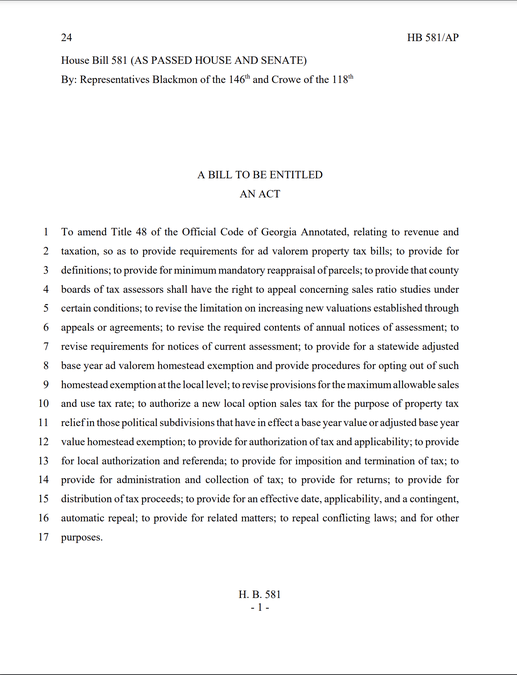
NEWTON COUNTY — Each city government, county government and school board in the state of Georgia has devoted some time in the past two months to deliberation over House Bill 581 (HB581), a statewide floating homestead tax exemption.
The ballot measure was met with more approval than opposition in Newton County, with approximately 59.98 percent of the county voting to pass it.
Though HB581 passed in the November 2024 statewide election, the measure stipulated that any entity could choose to opt out of implementing the homestead exemption.
However, these governing authorities had to decide by March 1 or would automatically be placed under the tax relief measure. As instructed, every entity in Newton County finalized a decision on the measure by the end of February.
The following entities voted to opt out. The tax exemption will not go into effect for their homestead residents.
- City of Oxford
- City of Social Circle
- Newton County Board of Education
The following entities voted to remain opted in. The homestead exemption will go into effect
- City of Covington
- City of Porterdale
- Town of Newborn
- city of Mansfield
- Newton County**
**The Newton County Board of Commissioners (BOC) never held a formal vote on how to proceed with HB581 as the cities and school boards did. But each commissioner at some point in the last two months of regular meetings indicated an inclination to let HB581 take effect. The body is not required to hold a formal vote on the matter and no public hearings were ever announced, so the BOC remained opted in.
FLOST
Because multiple entities within the county chose to opt out of HB581, the county can no longer implement the state’s proposed Floating Local Option Sales Tax (FLOST). The FLOST was the state’s recommended way for local governing bodies to make up for potential lost revenue under the homestead exemption.
The stipulation of the FLOST was that every entity would need to remain opted in to HB581 (except the school boards, who cannot gain revenue from penny taxes and therefore were exempt from this plan).
Even if all entities had remained opted in, the FLOST would still have had to pass as a countywide ballot measure, so its implementation was never a guarantee.
How would House Bill 92 play into this?
The March 1 deadline does not entirely close the door on Georgia’s homestead exemption conversation.
House Bill 92 is a piece of legislation that could change some of the details of HB581 and maybe cause some entities to reconsider their decisions. However, the bill is far from being law; for now it is just legislation that several local officials have indicated they are keeping an eye on.
The bill has also undergone many changes, with its contents continuing to vary almost daily. As of press time, the bill was still undergoing work in the State Senate, and its last update was Friday, Feb. 28. These are the changes it presently entails, as of press time:
House Bill 92 redefines the word “homestead” to include an acreage limitation.
“‘Homestead’ means homestead as defined and qualified in Code Section 48-5-40, with the additional limitation that it shall include: … Only the primary residence and not more than five contiguous acres of land immediately surrounding such residence …” it reads on page two.
Changes would also be made to the opt out provisions and the permanence of an entity’s decision.
“For the election to opt out of the homestead exemption otherwise granted by this Code section to remain effective for a political subdivision after tax year 2025, the governing authority shall comply with the same procedures and hearings required pursuant to paragraph (1) of this subsection and shall file a copy of the resolution with the Secretary of State by March 1 of each year.” the measure reads on page three.
The “paragraph (1)” references the three mandatory public hearings process and the associated legal notice requirements that many local governments have undertaken this year. This would make opting out and holding these meetings an annual process.
The bill would also diminish the permanence of an opt out decision.
“The governing authority of any county, consolidated government, municipality, or school district that has elected to opt out pursuant to this subsection may rescind such election at any time by adopting a resolution to do so and filing a copy of such resolution with the Secretary of State; provided, however, that such resolution to rescind the election to opt out shall only be effective for a tax year if a copy of the resolution is filed with the Secretary of State by March 1 of the such tax year.”
As of now, there is no indication that there would be a way for entities that opted in to HB581 to reverse that decision. However, the new bill’s revisions are far from being law, and its stipulations are changing daily.