NEWTON COUNTY — Local education leaders, elected officials and stakeholders gathered at Georgia Piedmont Technical College last week to discuss the state of education in Newton County.
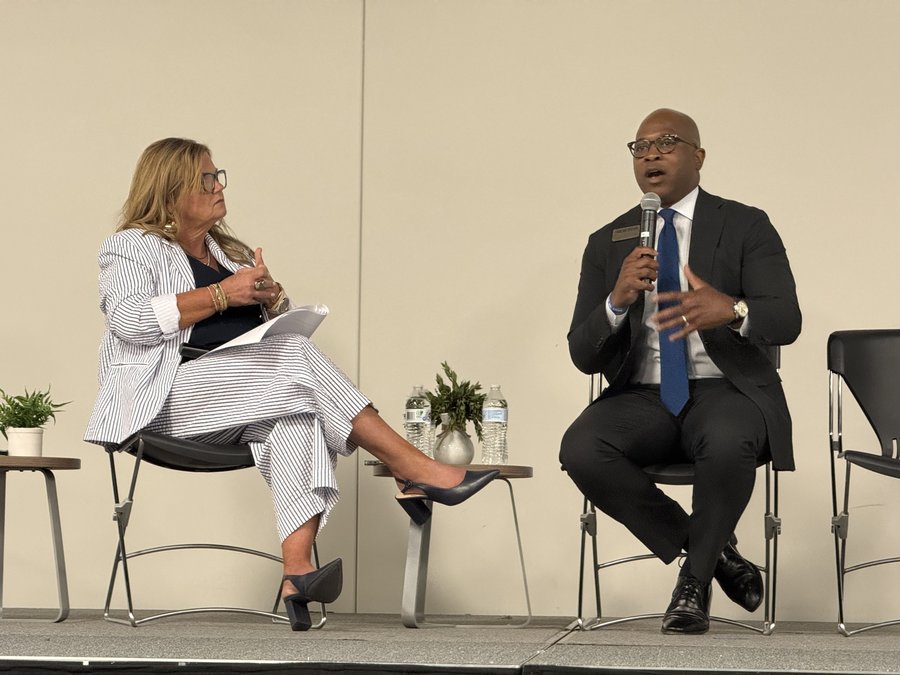
Hosted by the Newton County Chamber of Commerce, the inaugural State of Education forum gave those in attendance an insight into how each of the local schools is meeting objectives. Representatives from Newton County Schools, Georgia State University, Georgia Piedmont Technical College, Covington Academy, Peachtree Academy, Piedmont Academy and George Walton Academy took turns answering questions from the forum’s moderator, Chamber President Debbie Harper.
Newton County Schools
Speaking on behalf of Newton County Schools was Superintendent Dr. Duke Bradley III. In his nearly three school years as superintendent, Bradley says that he’s taken a front seat in learning about how the district functions and building toward the future.
“What we’ve been doing is preparing ourselves, building infrastructure, upskilling our people, developing new systems, making sure that we’re preparing ourselves appropriately for the next phase of work we’ve got to do as a school system,” Bradley said.
However, Bradley noted that the district has already been “moving the needle” on meaningful statistical categories.
“I’m proud of what we’ve done, but we also know that we have so much more work to do,” Bradley said.
But a school system such as Newton County Schools is impossible to operate without millions of dollars in funding each year. Funding for the district is made up of money from the state and local revenue — particularly home values and the millage rate.
Over the course of the last five years, the millage rate has either remained flat or decreased, something that Bradley gave credit to the Newton County Board of Education to.
“But the truth of the matter is that our board, to their credit, has done an incredible job in lowering the millage rate really to 30-year lows over the past two years and consistently since COVID,” Bradley said.
Bradley estimated that these measures have saved taxpayers around $19 million overtime. But with what Bradley called the “ambitious pursuit” to continuously lower property taxes, he noted that this could cause an issue for public school funding.
“There has not been very much conversation about the implications that it would have on public schools and public education, and I think that that’s something we should all be concerned about,” Bradley said.
Throughout his time on the podium, Bradley’s overarching message was that he wanted to find a way to close the gap between the school system and community expectations.
Bradley noted that the school serves an array of purposes outside of traditional educational standards, including safety, mental health support, remaining competitive and postsecondary preparation.
“I think it’s important for our community to, first of all, define success,” Bradley said. “We’ve got to say, ‘This is what we want for our young people.’ And then the extent to which we can deliver on that hinges on our ability to access and activate partners to be able to pursue those goals. When they’re a shared mission, shared values and shared accountability, there’s nothing that’s not possible.”
When asked about his vision for Newton County Schools, he said it’s not about how he thinks the district should operate, but rather, how the overall collective feels.
“I think the job for the community is to tell me what the vision is and then for me to deliver that to a framework of shared accountability,” Bradley said.
Private schools
Representatives from area private schools also spoke on the state of their respective programs. Much of the conversation was steered towards life after graduation and how each school is preparing their students for the world ahead.
Each official highlighted the different measures they are taking to provide skills for the world ahead.
At Covington Academy, around 35% of high school students are taking dual-enrollment, which will give them college credit. Pathways are a strategic emphasis at Peachtree Academy, with nearly all of the students participating in a pathway.
George Walton Academy Headmaster John Marshall said that study-abroad opportunities are available, allowing students to see different parts of the world and learn different perspectives. At Piedmont Academy, partnerships with alumni and community members to provide outside opportunities to students.
But one thing that all four schools had in common was an emphasis on work-based learning programs.
One such program is at Covington Academy where students can leave school at 10:20 to attend firefighter and EMT school. The goal of this program is to allow graduating seniors to leave high school and immediately contribute to society.
“Our internships are strong in Newton County,” said Amanada McCollough, founder and principal of Covington Academy.
All four officials agreed that securing stronger relationships with community partners was in the best interest of their schools.
“We would be very open and eager to partner with local businesses, entities and organizations here in Newton County for those internship programs,” Marshall said.
Colleges
Tying in post-secondary opportunities, representatives from Georgia State University and Georgia Piedmont Technical College gave an insight into how they are providing students opportunities in Newton County.
Dr. Barbara Johnson, dean of Georgia State University — Perimeter (which includes the Newton County campus) said that the school has added new pathways such as physical therapy assistant, dental hygiene and actuarial science programs. Johnson added that they have partnered with the film and healthcare industries to allow students to gain experience.
Another way Georgia State is getting involved is through workshops, something that Johnson stressed would take place more often to meet the needs of the community.
Additionally, Johnson said that the options for local students continue to expand, with a renewed emphasis on dual-enrollment option programs in the local school systems.
At Georgia Piedmont Technical College, Dr. Tavarez Holston said that preparing students for the workforce is their top priority. Holston shared that there is a particular focus on advanced manufacturing and healthcare in Newton County.
Two statistics that appeased the crowd were 20% — the growth percentage of the school — and 98% — the amount of students who go on to land a job after college. Holston said that this was thanks in large part to the partnerships with local industries and school systems.
Holston said that he wants to keep the positive momentum moving forward for Georgia Piedmont Technical College.
“There’s good stuff happening,” Holston said. “I’m excited about all of it.”