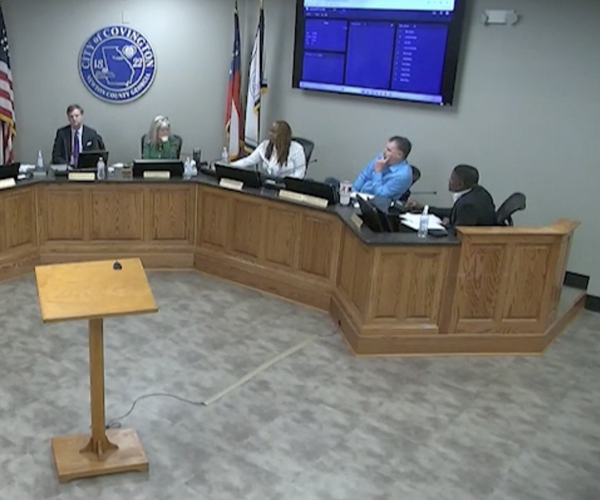

SOCIAL CIRCLE, Ga. –The Social Circle City Council took a first look Thursday at a proposed policy for leak adjustments to water and sewer bills.
The proposed policy, the first to be considered by the city, is designed to incentivize prompt and complete repair of leaks by water and sewer customers.
That, in turn, will assist the city in more efficient management of its water and sewer resources, according to documentation provided to the council Thursday for review between now and the council’s Oct. 21 voting meeting.
That meeting, set for 6:30 p.m. in the Community Room at 138 E. Hightower Trail, will include an opportunity for public comment on the proposed policy.
Under the proposed policy, a “leak adjustment” would be made in a customer’s water or sewer bill for two consecutive months of higher than usual water and sewer charges resulting from leaks occurring between the customer’s side of their water meter to wherever outside or inside the residence a leak is detected. Customers would be limited to one leak adjustment per 12-month period, according to the policy proposal.
One exception to the proposed policy is leaks caused by a failure to turn off a water spigot or hose. Beyond that, the proposed policy calls for considering leaks on a case-by-case basis. To be considered for a leak adjustment to a water or sewer bill, the proposed policy requires a customer to provide the city with information on the cause of the leak, proof that the leak has been repaired, and the filing of a form available online at SCUtilities@socialcirclega.gov.
The policy proposal calls for the required paperwork to be submitted by email to SCUtilities@socialcirclega.gov, online at socialcirclega.gov, or in person at City Hall.
Sewer leak adjustments would be handled differently from water leak adjustments under the policy proposal, with adjustments only being allowed if the leak occurs outside a residence. In such cases, bills would be adjusted to the customer’s average six-month usage rate.
Leaks inside the home would not be eligible for adjustment, the policy proposal notes, because the wastewater “must be treated (by the city) regardless of where the leak occurred.”
Under the proposed policy, water and sewer leak adjustments would appear as credits on affected customers’ bills.
The proposed policy also addresses the filling of swimming pools, which may qualify for a reduction adjustment when information such as the pool’s capacity, whether it is in-ground or above-ground, and photos of the water meter readings before and after the pool is filled are provided to the city.
Beyond the policy proposal, there was some discussion Thursday among council members and Social Circle City Manager Eric Taylor regarding how, or even whether, the city should turn off water service to customers whose usage is far outside the norm.
Currently, the city uses door hangers to notify residents when it has noticed a household’s use of water and sewer services exceeds their normal usage. Taylor suggested Thursday that the city might want to consider turning off service after the second month that a door hanger has been placed on a customer’s residence noting excessive water usage.
City Attorney Tony Powell cautioned that the city could not simply turn off service, but would need some sort of defined procedure for instances in which usage is excessive.
Councilman Tyson Jackson was particularly adamant about turning off service to customers whose usage is excessive.
“At some point, we need to get their attention,” Jackson said, noting that the city’s responsibility for water service extends to all citizens, and excessive use is a waste of the municipal water supply.
Data center review
In other business at the non-voting Thursday work session, the city council got a review of a set of annexation, rezoning and special-use permit requests for two family-owned tracts, totaling more than 150 acres, along Hawkins Academy Road and Roy Malcom Road.
Members of the family that owns the acreage are working with Thomas & Hutton, an engineering and land planning firm with offices in Atlanta and across the Southeast, and Carrollton-based Atlas Development, to establish a data center on the site.
Data centers are massive facilities filled with computer servers and other hardware designed for the storage, processing and distribution of large amounts of digital data. Data centers require significant quantities of electricity, and water for cooling, which can severely impact local infrastructure. The data center proposed for the tracts at Roy Malcom and Hawkins Academy roads would comprise three two-story buildings, comprising 1.5 million square feet, along with an electrical power substation.
Interestingly, the 150-plus acres are located near a 300-acre tract on Amber Stapp Studdard Road at Social Circle Parkway for which Florida-based Sailfish Investors, another data center development firm, was successful in getting an annexation and rezoning from the city council earlier this year for a planned 1.8 million square foot data center. Since then, however, the proposed project appears to have hit a roadblock.
Similarly, a site at Interstate 20 between Georgia Highway 11 and Social Circle Road, for which the city council approved a special-use permit a few months ago, also appears to have foundered.
Last month, faced with an influx of rezoning and related requests for data center projects, the city enacted a 90-day moratorium on those requests. The rezoning and related requests for the acreage at Roy Malcom and Hawkins Academy roads were filed with the city prior to enactment of the moratorium.
The requests for that acreage came to the city council Thursday with recommendations from the Social Circle Planning Commission, which serves the city council in an advisory capacity, that the annexation, rezoning and special-use permit applications, along with a request for an amendment to the city’s future land-use map, be rejected by the council. The council is not bound by any planning commission recommendations.
The council was led through the requests for the data center by Cody Ellis, a planner with the city’s Community Development Department. Ellis told the council that the planning commission had been concerned about the fact that no “end user” has been identified for the data center, and that there was no concrete information regarding plans for water, sewer and electrical service.
“End users” for data centers routinely come from the ranks of digital technology giants like Google and Amazon. The only data center currently operating in the area is the Meta (formerly Facebook) facility in the Stanton Springs industrial and mixed-use development off I-20 near Social Circle.
Ellis said the planning commission viewed the latest request aimed at setting up a data center as “one of the gold rush things,” an apparent reference to the fact that in recent months, the state of Georgia has become a hotbed for proposed data center development.
The council had few questions or comments on the zoning actions requested for the latest proposed data center, outside of Councilman Tyson Jackson wondering why the proposed facility couldn’t simply be located at the Amber Stapp Studdard Road site.
The council will consider the requests for the Roy Malcom and Hawkins Academy road tracts at its Oct. 21 meeting, during which there will be an opportunity for public comment.