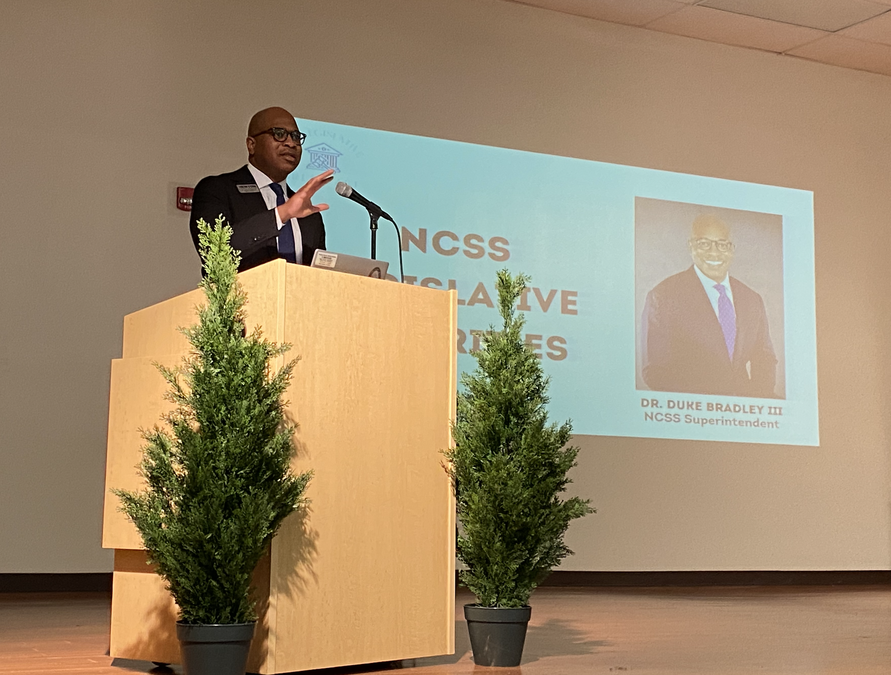
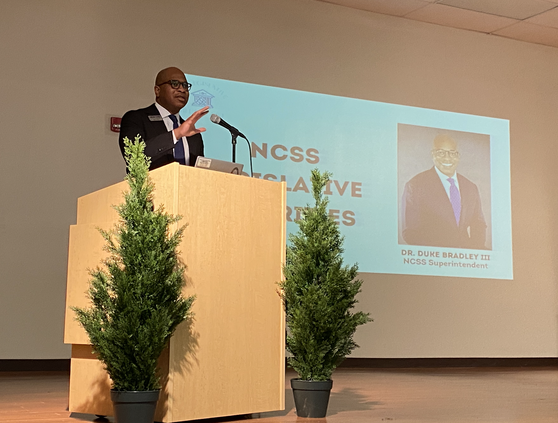
NEWTON COUNTY—At the Newton County Chamber of Commerce’s Pre-Legislative Breakfast on Jan. 8, Dr. Duke Bradley III, superintendent of Newton County Schools (NCS), voiced his support for state legislators to take a look at how public schools are funded during this year's Legislative Session.
Bradley delivered opening remarks at the breakfast, which was held at the Newton College and Career Academy. Before the main event, which was a Q&A with State Representative Clint Crowe, Bradley highlighted some key points of the district’s own 2026 legislative priorities.
The priorities, which were outlined publicly at the Nov. 18, 2025 NCS Board of Education meeting, have overarching themes of increasing school funding, providing taxpayer relief, expanding opportunities for students, strengthening the educator pipeline and supporting mental health and safety.
Bradley’s address on Thursday touched on multiple of these topics, but centered most around the interconnectedness of school funding, taxpayer relief and its implications on the quality of education.
“We are simply communicating that in order for us to deliver the kind of quality education that corresponds with our mission, which is to provide excellent education for all students, we believe that there needs to be a corresponding funding formula that supports that,” Bradley said.
A specific point of Bradley’s remarks was about Georgia’s 1985 Quality Basic Education (QBE) Act, which created a funding formula that determines how public schools across the state are funded. According to the Georgia Department of Education webpage on QBE Reports, the QBE formula determines what funding districts receive from the state based on variables like student enrollment, instructional programs and teacher training and experience, to name a few.
Bradley shared his belief that the 1985 QBE formula is outdated and forces districts to have an overreliance on revenue obtained through property taxes, placing an unsustainable burden on Newton County homeowners.
“What we are advocating for is a modernization of the current QBE formula, which as I mentioned, was first developed way back in 1985,” Bradley said. “This is not a new issue. And quite frankly, it is not necessarily just a Newton County-specific issue. Almost every single school system in the state has lifted up modernizing the Quality Basic Education Act as a primary and foremost legislative priority.”
This tied into taxpayer relief, with Bradley calling the continual funding needs of the school districts “largely burdensome” on property owners.
“... [NCS] millage rates have been lowered to the lowest point that they’ve been in thirty years, and when I talk to my superintendent colleagues across the state, they ask me, ‘With you continuously lowering your millage rate, how are you investing in kids? How are you advancing public education? How are you making sure that you’re keeping up with the advances of public education and technology and all of the things that we know make for robust, comprehensive educational experiences for young people?’” Bradley said. “Well, we’re doing the very best that we can, but what we also know is that it is unsustainable.”
Circling back to funding, Bradley said that public education was not intended to be as heavily funded by property taxes as it is today. To address the funding distributions, Bradley said that the board has been active ahead of Georgia’s 2026 Legislative Session.
The superintendent shared that the NCS Board of Education—and specifically Board Member Trey Bailey—has “developed potential legislation” to address this.
“We’ve said that there are ways to be creative around financing and funding public education that relieves some of the burden from our homeowners, and we’re really excited about that,” Bradley said.
Bradley did not delve further into the finer points of the board’s ideas, nor did he detail how their plan might be shared with the lawmakers this session. But speaking plainly, he repeatedly called the current method of funding “unsustainable.”
The superintendent shared that the year-to-year lowering of the millage rate does not benefit the school district in providing top-tier education, but that homeowners have been vocal about the property burden being too great already.
“We also believe that a more balanced funding structure protects taxpayers and it ensures that our schools are more resourced to support student achievement and be more responsive to community expectations,” Bradley said.
But a word of caution was shared with Bradley stating that, though he is optimistic for a change, this has already been a topic of conversation for several years across the state.
“What we’re doing right now cannot persist.”