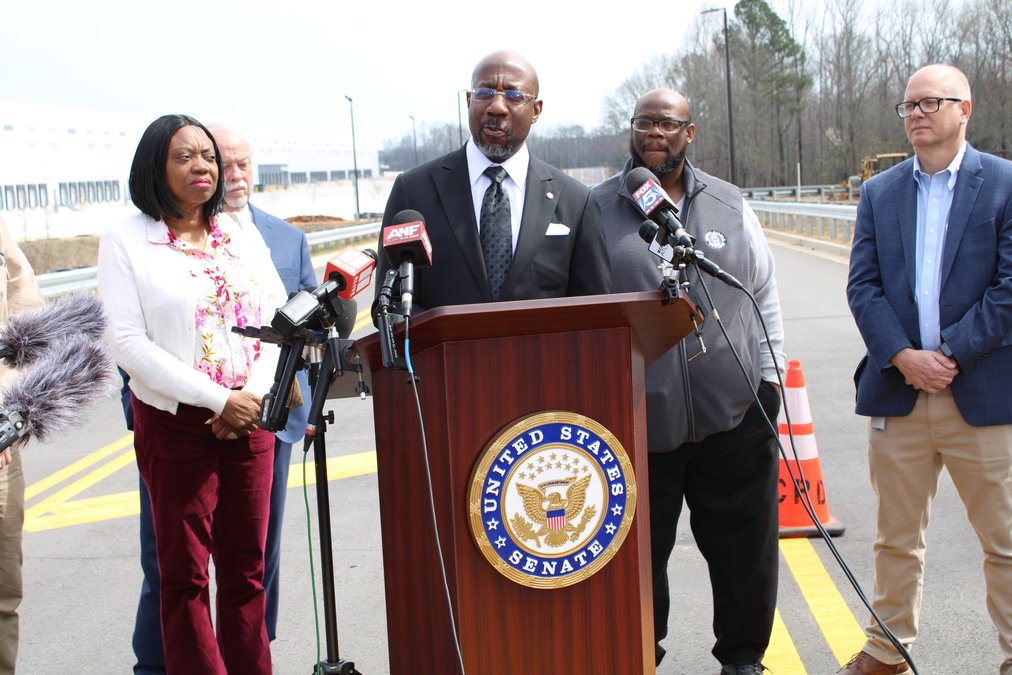
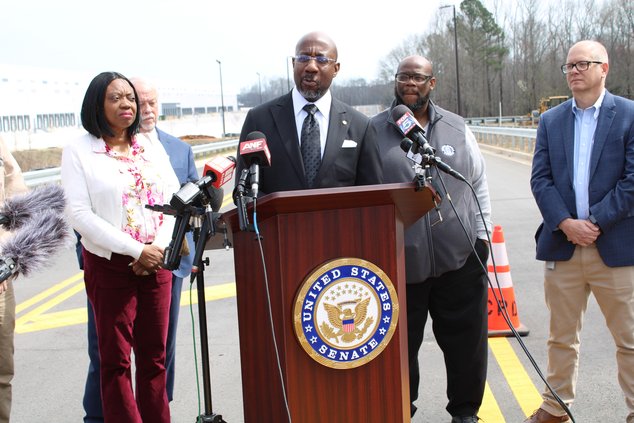
SOCIAL CIRCLE, Ga. – In anticipation of the implementation of a U.S. Immigration and Customs Enforcement (ICE) facility in Social Circle, the city received a visit from U.S. Sen. Raphael Warnock.
Warnock, a Democrat who has represented Georgia in the U.S. Senate since 2021, met with Social Circle Mayor David Keener and Social Circle City Manager Eric Taylor to take a guided tour through the city’s drinking water and wastewater treatment sites. The group then viewed the proposed ICE facility from a distance as unmarked cars guarded the entrances.
Once activated, the anticipated site is expected to accommodate anywhere from 5,000-10,000 detainees awaiting deportation. This will effectively triple Social Circle’s current population of 5,000 residents.
Warnock filed a legislative amendment in Congress to block the development of ICE centers in Georgia on Friday, Feb. 13.
After Monday’s tour, Warnock made his stance crystal clear.
“Folks in Social Circle voted for this president overwhelmingly,” Warnock said. “But here’s what they didn’t vote for: They did not vote for a 10,000-person detention center that will triple the size of their town and that will place a massive detention center next to an elementary school.”
Warnock said that he was met with resounding opposition to the facility during discussions with teachers and officials at the newly-built Social Circle Elementary School, which is approximately a mile from the warehouse. Local officials on both sides of the political aisle have also come out against the creation of the ICE center.
Many concerns are not necessarily rooted in President Donald Trump’s immigration policy, but rather infrastructure concerns that would come with a facility this large.
Taylor said that the city is only permitted to use 1 million gallons of water per day. During the hottest temperatures, he said that 80 to 90 percent of the allotted amount is used with the city’s current population of 5,000. He added that the sewer system is operating at a capacity of 660,000 gallons per day, far more than the expected additional 1 million gallons per day needed for the site.
After seeing Social Circle’s facilities up close, Warnock was equally concerned about the potential infrastructure strain.
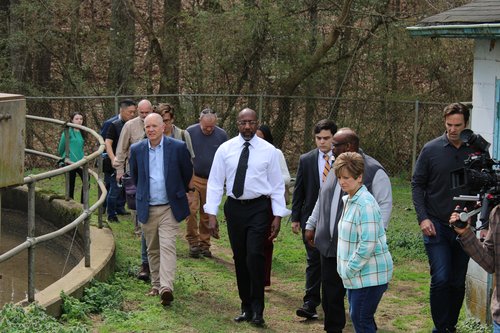
“I’ll tell you something else they didn’t vote for: They didn’t vote for potential boil-water advisories or sewer overflows because this administration has overstrained their city’s resources,” Warnock said. “They didn’t vote for their voices to be unheard and trampled by their own federal government.”
This sentiment has also been echoed by Social Circle officials.
“We simply do not have the water and sewer capacity to handle the demands that would effectively be tripling our city practically overnight,” Taylor said.
Another repeated concern throughout the process has been the communication—or a lack thereof—between local and federal officials. Keener told The Covington News on Monday that he himself still has not personally heard from anyone from the Department of Homeland Security.
This seemed to surprise Warnock during Monday’s press conference.
“I’m struck by the utter lack of conversation between the administration and the people who run the city,” Warnock said.
Similarly, Warnock confirmed that the federal government has been tight-lipped in response to his own inquiries about the project.
“We have reached out to them. I have written them. I have asked them for answers,” Warnock said. “So far, crickets.”
Economic concerns were also at the forefront of Monday’s visit.
Taylor said that the city had collected $300,000 in property tax revenue from the former owners PNK Group in 2025. The city is expected to receive $500,000 this year and was scheduled to generate over $1 million in subsequent years.
However, the property will no longer generate tax revenue for the city under DHS ownership, as government-owned property is tax-exempt.
“Where are we supposed to recoup that kind of money?,” Taylor asked.
An expected creation of 2,500 jobs associated with the facility, though Taylor has noted he is uncertain how the roles will be filled.
Taylor said that if ICE were to target existing law enforcement officers, it could create yet another issue.
“Will they offer wages and bonuses to begin to cherry-pick the police officers, sheriff’s deputies and county officials from Social Circle and other areas?” Taylor asked. “Well, that will force every local government around here to raise taxes just to be able to compete with a limited supply of workers.”
On the taxpayers’ side, The News first reported last month that the federal government had purchased the property for $128.5 million, just under $100 million more than what the property was worth according to tax records.
When asked if he felt it was an overreach of tax dollars, Warnock said that ICE’s $75 billion in funding from the Big Beautiful Bill is more than all of the federal law enforcement agencies combined.
“They got a lot of money to throw around, and so this is what you end up with,” Warnock said. “Meanwhile, the people in this city are trying to figure out the cost of groceries and what they’re going to do in terms of infrastructure to manage this type of huge build that is happening in their backyard without any discussion with the folks who actually live here.”
The City of Social Circle previously said in a social media post that detainees were told that detainees will be housed at the facility starting in June. But if there was any message from Monday’s event, it’s that Social Circle officials and Warnock are still looking for a way to stop it.
“Whatever happened to local control?” Warnock asked. “Whatever happened to my friends, particularly on the other side of the aisle [who] talk about the importance of respecting local communities? I guess that’s all gone out the window.”