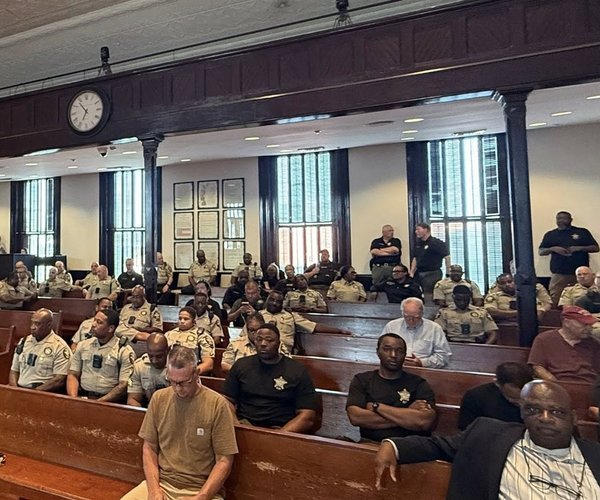

NEWTON COUNTY — The current draft of a broad revision of Newton County’s Unified Development Ordinance, which covers zoning, development regulations and water resources, includes a proposed new “Technology Campus” (TC) zoning district aimed at regulating data centers. Proposals for data centers — massive facilities for the collection, storage and distribution of huge quantities of digital data — have become a regular feature of development issues in the county.
As currently proposed, the ordinance revision, applicable to unincorporated Newton County, would require data centers to be located on a minimum of 300 acres, either in areas zoned TC or M2, a heavy industrial zoning classification. In either classification, a conditional-use permit – an additional layer of county oversight on zoning and land-use issues – would be required for a data center.
However, a county steering committee working with Kendig Keast Collaborative, the multidisciplinary nationwide planning consultancy firm retained for the code revision, has suggested a minimum lot size of 1,000 acres for data centers. That limit was proposed, according to Brian Mabry, president of Kendig Keast Collaborative, “as a way to make sure that these (data centers) are accommodated on extremely spacious properties and limit their impacts on adjacent properties.”
If community sentiment and county government direction warrants it, the minimum lot size for data centers could be changed to 1,000 acres in a subsequent draft of the unified development ordinance, Mabry said at a recent joint meeting of the Newton County Board of Commissioners and the Newton County Planning Board.
Interestingly, though, the draft ordinance revision also contains a provision that would allow data centers in existing buildings in areas zoned OI (Office-Institutional) or M1 (Light Industrial), on a minimum of 10 acres, although Mabry said at the joint meeting that the broad preference of the steering committee was to limit data centers to TC and M2 zoning districts.
“We heard from some other steering committee members at one point that there’s technology that is allowing for smaller data centers that can take place in buildings that are currently unused, and so that was a carve-out as an accommodation for that,” Mabry said at the joint meeting.
Nonetheless, given the community’s concerns with data centers, Commissioner LeAnne Long, the county commission’s vice chairman, took steps at the meeting to tamp down any community consternation that might developer over even a hint that data centers could go on otherwise qualified 10-acre tracts.
“I want to make sure that anybody seeing this or watching this understands that this (proposed development ordinance revision) definitely is a draft,” Long said. “There was a lot of flare-up about this 10-acre thing, so I don’t want anybody to think that we’re about to do this, because … there’s a lot more discussion to be had … before anything happens, so I just want to make sure we make that clear.”
Kendig Keast Collaborative’s work on the unified development ordinance began nearly two years ago, with a public outreach component conducted from September to November of that year. Adoption of the updated ordinance could come in late summer, after public review of the draft proposal.
Long, however, was at least somewhat skeptical of the county meeting that deadline for adopting a new unified development ordinance, noting she had not heard of the TC zoning until the day before the joint May meeting, and also noting that despite the new proposed zoning classification, data centers are mentioned in other parts of the county’s zoning regulations.
“I think we want to tighten that up as a county,” Long said, “and as a planning board and as citizens, we have to decide if we’re going to be data-center-friendly or not.”
As an immediate step, Long suggested that the commission have a work session with the county manager to look at the TC zoning and other aspects of the unified development ordinance update, “where we can really kind of dig into these things and get this together, or we’re not going to meet those deadlines. I can assure you that we’re not going to meet those deadlines if we don’t take four or five hours in one day and have a work session on these things” including public input.
“We’re listening to the citizens of this county,” Long continued. “We need to have rules that people like and can live by.”
In addition to the proposed zoning district limitations, the proposed revisions to the unified development ordinance with regard to data centers would require that buildings be set back 1,000 feet from nearby residences, and 100 feet from any other land use, with a 150-foot-wide landscaped buffer on the property, and a building height limit of 90 feet.
The proposed revisions would also require that data centers be located within 1,000 feet of existing adequate public infrastructure. The term “adequate” is a clear reference to the amount of electricity needed to power the computer servers that are the heart of data centers, and to the water needed to cool that data processing equipment in those centers.
Regarding water, the proposed unified development code revisions would require data centers to use “closed loop” cooling systems as a means of limiting water use.
Further regarding utilities, data center developers would be required to submit verification from water and electricity providers that their planned facilities would have adequate service.
“It can’t be a generic letter,” Long contended. “It has to be a detailed letter, based on what they’re building, and (in terms of water) how many gallons that they need.”
“I think we’ve already started in that direction here in Newton County,” Long added.
Other controls over data centers in the proposed revision of the unified development ordinance include some design standards “so that the building is at least somewhat attractive,” Mabry said, along with regulations and controls over noise, heat emissions and vibration from such facilities.
Mabry told attendees at the recent joint meeting that data centers have been “a very hot topic everywhere that we work. … You don’t even have to be a city planner or an elected or appointed official to know that’s a very controversial subject all over the country.”
Ins and outs
In other developments at the May joint meeting, Mabry took the county commission and the planning board through some recent changes in the proposed draft revisions to the unified development ordinance.
Tiny houses, defined as dwelling units of 400 square feet or less, have been put back into the proposed ordinance, based on feedback from the county’s own planning staff and other sources, Mabry said.
In the latest draft ordinance, tiny houses would be permitted in some limited zoning classifications, in combination with a conditional-use permit and some design requirements, along with sewer connection requirements and garbage and mechanical equipment screening requirements.
Taken out of the latest draft ordinance were incentives for infill development, which allows for development of unused lots within a particular zoning classification.
“That didn’t seem to be a really big priority, or an essential priority, for the county,” Mabry explained.
Also added to the proposed ordinance draft, but as a prohibited use, are halfway houses, generally defined as places where people coming out of jail or prison can stay while transitioning to life outside confinement. Such facilities, Mabry said, “tend to need adjacency or proximity to public transit due to the nature of the use, where it is someone coming out of jail or prison and trying to transition back into conventional society.”
ADU standards
The latest draft ordinance also includes a set of standards for accessory dwelling units (ADUs), whether attached to an existing residence or located on the same lot as the main residence. In both instances, the floor area of an ADU can’t exceed 50% of the floor area of the main dwelling, or 1,000 square feet, whichever is less. Also, whether attached or not, an ADU requires one dedicated parking space on the dwelling lot.
A detached ADU must, under the proposed ordinance revisions, be compatible with the main residence in terms of roof pitch, porch design, eaves, the alignment and shape of windows, and color.
CORD changes
Also currently in the works as proposed changes to the unified development ordinance are adjustments to the Community Oriented Residential Development (CORD) zoning classification, a mixed-use development option.
The major proposed change would stagger development of CORDs, requiring that half of the commercial component of a development must be built and issued a certificate of occupancy before building permits can be issued for the final two-thirds of planned residential development. The proposed change is designed to ensure that land designated for commercial development in a CORD is not left undeveloped as residential development proceeds, attendees at the joint meeting learned from Mabry.
Also under the proposed CORD changes, the county commission would have the final word on residential densities in those developments, without regard for what is or is not allowed within the CORD’s underlying residential zoning classification.
The proposed changes would limit the “base” zoning districts to which a CORD could be applied to agricultural-residential districts outside protected watersheds, single-family residential, and mixed-use single-family residential classifications.
The proposed changes also would add architectural and aesthetic standards to CORD developments.
At the joint meeting, Long was adamant in her opposition to the CORD zoning, contending that it took some of the county’s remaining rural character with it.
“I feel like every zoning (rezoning request) that we’ve had in the last two years comes in as a CORD, because that gives people the highest density,” Long said.
“That’s a concern to me,” she continued, “because Newton County’s vision is not to be Roswell or Alpharetta.” Both of those towns are part of metropolitan Atlanta, and both are faced with managing development density in the face of residents’ concerns about the character of their respective communities.
In Newton County, Long contended, “people here still want the rural neighborhood, they want some neighborhoods that have some land with them. If they want to live on top of each other, there are places in Newton County where they can live on top of each other.”
Overall, Long said, the county’s vision is to “not have the whole county as one” type of development.
As the joint meeting wound down, Long praised Kendig Keast Collaborative for their work in Newton County “and how you’re really turning it toward what Newton County wants.”
“That was my biggest concern at the very beginning,” Long said, “that we were going to turn into a cookie-cutter book, and that’s not what we want at all here. We want to do something that works for everyone in this county, and we’re listening to what the people are telling us.”
“Hopefully,” Long continued, “more people will come forward and look at it (the proposed ordinance revision) and give us more input of what they would like to see from these meetings that we’re having.”