COVINGTON, Ga. — In the past year, the words “data center” have been a recurring item on agendas of local governing bodies across the area. This has resulted in public outcry, both on social media and in person at the various meetings.
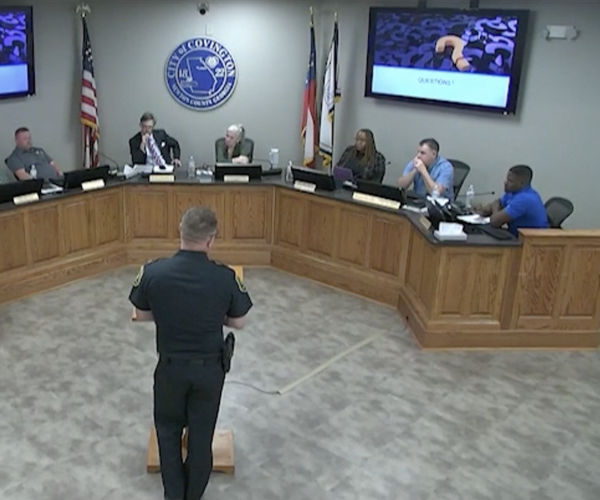
“Data center” was once more on an agenda at the City of Covington’s Jan. 5 council meeting, but in a different capacity than before. This time, the council members initiated action to revise its data center zoning ordinances and implemented a 180-day moratorium on new requests.
The six-month moratorium puts a pause on new data center requests, meaning that the city will not hear any new requests in that time. During the moratorium, the city staff will review the current ordinance and offer a recommendation to the planning commission, which will then offer a recommendation to the city council.
Overall, the process can take several weeks, and the moratorium ensures that the city has adequate time to undergo all steps before being asked to consider another data center request. But the moratorium has no effect on the data center requests that are already under consideration or in arbitration.
The proposal for the ordinance revision and accompanying moratorium was brought forth by Council Member Travis Moore, who specifically wants to change some of the “by right” allowances in the current ordinance.
According to Judy Thagard, the city’s planning and development director, the current ordinance was implemented in September 2023. It allows data centers to be built on properties zoned Light Industrial (M1) or Heavy Industrial (M2) “by right.”
“So if we have a property that is zoned M1 or M2 and it's already zoned and it's in the city, and we have a request come in, that is one that it could just automatically go in without further review,” Thagard said.
Additionally, data centers can be built in Neighborhood Mixed-Use (NM), CM, Corridor Mixed-Use (CM) or Town Center Mixed-Use (TCM)-zoned properties, but they require a special use permit. Developers obtain special use permits by submitting a request, which can be accepted or denied.
Moore proposed changing the ordinance so that M1 and M2 properties must also seek a special use permit to construct data centers. He also requested removing TCM from the acceptable zones altogether.
Thagard recommended that a specific definition be created and that supplemental standards be explored, such as not allowing data centers to exist within a certain distance from a residential area.
“I love the idea of adding the supplemental language, like setbacks,” Moore said. “Cause I think there needs to be a great separation between residents and any kind of data center.”
Council Member Jared Rutberg offered the room some explanation as to why the ordinance was written to include TCM, CM and NM back in 2023.
“...Right now we're thinking about these giant data centers, but there's also—the data centers also encompassed small ones,” Rutberg said. “Like if somebody was going and hosting websites and they just needed 1,500 square feet worth of servers, which is not like some of these monstrous server farms we're talking about. That's why there was [data centers] allowed in those areas.”
The council members voted unanimously to implement the moratorium for the purpose of revising the city’s zoning ordinances to be better suited for the influx of data center requests. A second unanimous vote initiated the process to amend the city’s ordinances to require special use permits for data centers in all zones.
The next public action on the matter will be when it goes before the planning commission. Though a date has not been set, it will likely not occur until at least February due to meeting advertising laws.
Data center moratoriums across the area
The City of Covington’s data center moratorium is not the first that has come to the local area.
In September 2025, the City of Social Circle enacted a 90-day data center moratorium on data centers. The moratorium remains in effect today, as the council voted to extend it an additional 90 days on Dec. 4, 2025.
Members of the Newton County Board of Commissioners have also been vocal about data centers, specifically due to annexation requests that have been stacking up on the county’s desk.
Newton County’s zoning only permits data centers to be built in the Stanton Springs overlay. Knowing this, developers have been approaching the various cities, seeking annexations into their city limits to allow what was county land to be the site of data centers.
This idea is corroborated in a Dec. 19, 2025 Facebook post by Newton County Commissioner LeAnne Long. Long represents District 5, parts of which are in the City of Covington.
“I believe the most effective approach is to directly engage with city leaders, respectfully conveying that additional Data Center developments are not for Newton!” Long wrote. “...The BOC [Newton County Board of Commissioners] has been opposed to these annexations. The county zoning ordinances states that only Stanton Springs allows for data centers, so developers go to cities to get these projects done.”
Ahead of Monday’s Covington City Council meeting, Moore posted an explanation on his Facebook page that shared how the city and county are required to take annexation requests under consideration, even if they themselves are not in support of the prospect.
“I also want to be clear—we are not having developers knocking on our door every day trying to build data centers here, and the City of Covington is not actively seeking to annex Newton County property for data center development,” Moore wrote. “...It’s also important to note that when property owners in the county request annexation into the City of Covington, we are legally required to accept the application and advertise it. That does not mean we are required to approve the annexation.”