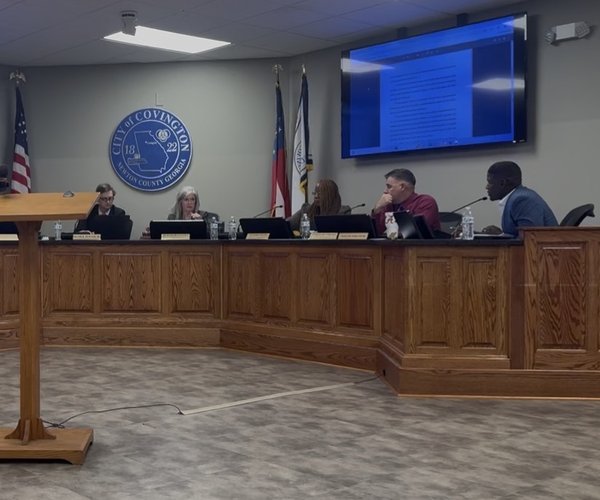

COVINGTON, Ga. — A request to amend the City of Covington’s short-term rental ordinance to prohibit business activity in short-term house rentals—like Airbnb or Vrbo properties—was voted down 2-3 during the March 16 city council meeting.
During the meeting, Mayor Fleeta Baggett brought the request to the table. Baggett shared that her request stemmed from nuisance complaints about tourist-targeting activities that occur in residential neighborhoods, specifically when visitors rent an Airbnb or similar property to set up shop.
Baggett said she has seen pop-ups, meet-and-greets and mini-stores operate from these short-term rentals.
“When we agreed to have Airbnbs, we did not agree for people to open up mini businesses several times a year when these conventions come into town,” Baggett said. “And it truly has become a nuisance to the neighbors that were OK with them being Airbnbs, but are not OK with them being little mini-stores, where you’ve got people coming in the front door, people coming out the back door, people standing in line, the traffic issues.”
The mayor added that earlier on Monday, she had seen an advertisement for one such meet-and-greet charging $1,000 for 12 minutes.
“That is highway robbery, and it’s also—we look like a tourist trap,” Baggett said. “And our town can be known for a lot of things, but we’re not going to be known for a tourist trap.”
Baggett named Floyd Street, Conyers Street and Carroll Street as specific locations from where she had received complaints of this activity.
During the discussion, Council Member Charika Davis asked how amending this ordinance could affect the film industry if a director wished to rent a house to film in. But Baggett said that film directors approach renting differently.
“If they’re filming, then they’ve gone around, they’ve knocked on the doors, they’ve told them,” Baggett said. “Some people get a nuisance fee. They’ve worked that out with their location people. There’s somebody there all the time.”
Davis also asked how many complaints the city had received about such activity. While Baggett said she’d probably received at least 10 emails about it, City Manager Tres Thomas couldn’t speak to any formal complaints, deferring to Judy Thagard, the city’s director of planning and development.
“I have had several people state that these are nuisances,” Thagard said. “But official complaints, no, I can’t say, and I didn’t check with the police department.”
However, Thagard did say that the current short-term rental ordinance contained a provision that could allow the city to revoke the property owner’s short-term rental license in the event of documented violations.
“If we can prove that there are violations happening, if there’s enough evidence, and if someone came forward—a neighbor—and came forward, there is a provision in the short-term rental ordinance to be able to move forward with revoking the license,” Thagard said. “So it is enforceable, but it really relies on people filing a formal complaint.”
Section 16.20.635(J) of the city’s code refers to “nuisance behavior of the rental guest” as an activity that could result in a citation for code violation.
“When a property owner has accumulated three code violations for a particular property within a period of twelve (12) consecutive months, the city shall revoke any pending certificates and reject all applications for the subject premises for a period of twelve (12) consecutive months following such revocation,” states Section 16.20.635(J)(1).
Thagard informed the council that the City of Covington would not be the first city to enact additional provisions ensuring business ventures are not operating out of short-term rental homes.
“If a business is ran as a short-term rental, we would not be the only community that would restrict it to being that [the rental] is the business,” Thagard said. “Because these are in residential districts. So you’re allowing somewhat of a commercial use inside a residential district.”
Thagard said that there is no current language in the ordinance that restricts the short-term rental of the home to being the only business activity on the property.
“We need additional language right now,” Thagard said.
Council Member Anthony Henderson asked Thagard how this compares to the way the city regulates yard sales. Thagard said that the recently adopted changes to the temporary commercial ordinance limit homeowners to four yard sales each year.
She also stated that the goods sold at yard sales are inherently different, as they are personal items found around the home, not a collective sale of a mass-produced good, such as t-shirts or souvenirs. Even people who sell homemade baked goods or fresh produce from their homes are expected to obtain a cottage food license from the city.
“A yard is supposed to be items that you are selling that is things that is your trash and someone else’s treasure,” Thagard said. “It should not be setting up for sales of products that’s not part of the residential home or part of what you are [selling at a] garage sale.”
Baggett emphasized that these short-term setups in residences not only bother the neighborhood but also directly compete with the local businesses that promote similar products or experiences.
“They don’t have a business license, so therefore we’re not collecting any taxes,” Baggett said. “And they’re going straight up against our brick and mortar [businesses] that pay for taxes 365 days a year, have to have the proper insurance and all that stuff. We have none of that being covered at these Airbnbs when this is going on.
“And if they decide to give them a glass or wine or a glass of champagne or whatever, that’s a whole other problem cause they’re not getting catering licenses when they’ve got people in there with bar carts.”
Ultimately, the council voted 2-3, with Henderson, Davis and Council Member Dwayne Turner voting against the proposal. Council Members Jared Rutberg and Kim Johnson voted in favor.
Council Member Travis Moore recused himself from the conversation and vote, citing his own ownership of several short-term rentals.