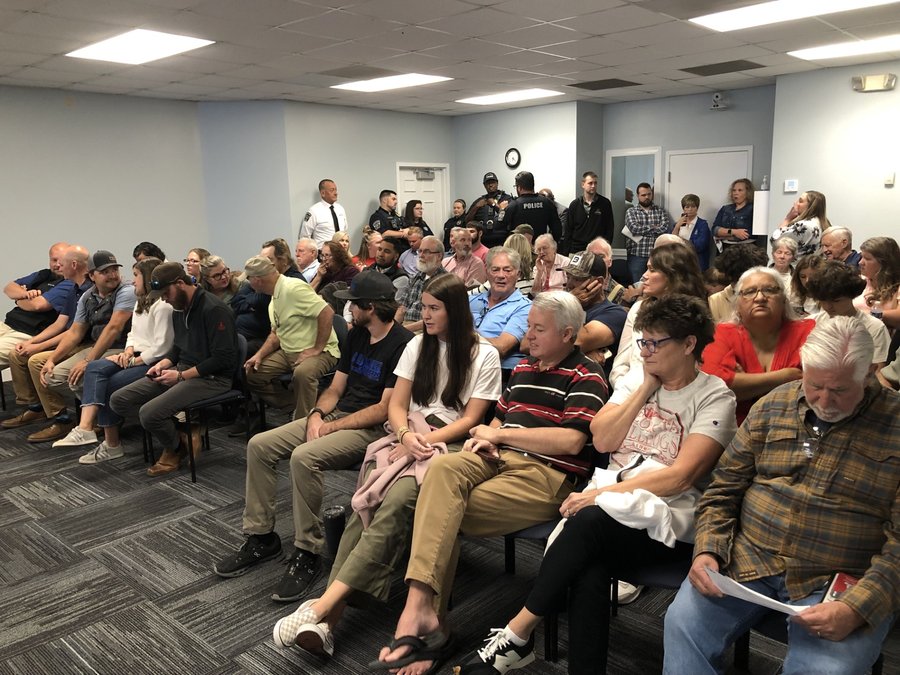
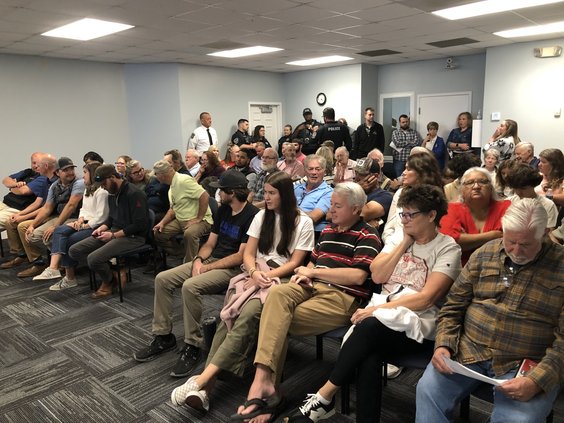
A crowd estimated at nearly 100 people, about half of whom couldn’t be admitted to a jammed Oct. 21 Social Circle City Council meeting and instead had to stand in a driveway outside the city’s Community Room, prompted the council to table consideration of annexation, rezoning and other zoning-related requests for a proposed data center that had brought the crowd to the meeting.
Data centers typically are very large facilities, often measuring 1 million square feet or larger among multiple buildings, that house computer servers and related digital equipment used for the storage, processing and distribution of large amounts of digital data. In recent months, Georgia has become a hotbed for data center development. And while it predates the current rush, Meta (formerly Facebook) operates a data center in the Stanton Springs industrial and mixed-use development off Interstate 20 just outside Social Circle.
As part of the Oct. 21 tabling decision, the city council voted unanimously to reschedule what was to have been a public hearing and potential votes on the annexation and zoning-related requests to a Nov. 6 meeting. Set for 6:30 p.m., the Nov. 6 meeting will be held at the old Social Circle Elementary School, 240 W. Hightower Trail, where a cafeteria, auditorium or a gymnasium can accommodate a much larger crowd than the Community Room at 138 E. Hightower Trail, the council’s regular meeting place.
Also as part of the tabling decision, the council indicated that it may modify its time limits on public comment for the Nov. 6 meeting, to ensure that people who want to speak on the issue will have sufficient time to make their points. While it appeared at the Oct. 21 meeting that most people who signed up to speak were likely to oppose the data center, Mayor David Keener said there were some who had signed up to speak in favor of the proposal.
In addition to the annexation and rezoning requests, the data center proposal includes requests for a special-use permit to allow such a facility in an area zoned for light industrial use, and for an industrial-related amendment to the city’s future land use map.
Councilman Tyson Jackson pushed particularly hard for rescheduling the Oct. 21 public hearings on the various requests related to the data center proposal in order to accommodate a large crowd.
“This is a big decision that’s going to affect the people out there (in the Community Room driveway) as well as the people in here,” Jackson told his council colleagues.
Data centers typically are very large facilities -- often measuring 1 million square feet or larger among multiple buildings -- that house computer servers and related equipment for storage, processing and distribution of large amounts of digital data. They use large amounts of electricity, and their water use can represent a significant potential strain on local water resources.
In recent months, Georgia has become a hotbed for data center development. In that time, Social Circle has fielded a number of zoning and annexation requests for data centers, prompting the council last month to establish a 90-day moratorium to allow the city to work through a backlog of such proposals.
The situation with data centers also has become somewhat problematic in the city. In two recent incidents, the council has approved annexation and zoning actions for data center proposals that are not coming to fruition.
The data center proposal now in front of the council for consideration and potential votes on Nov. 6, was submitted prior to enactment of the moratorium. It comprises 151 acres on Hawkins Academy Road and Roy Malcom Road, with plans for the site calling for construction of three two-story buildings, containing nearly 1.5 million square feet of space. Atlas Development, a Carrollton-based data center development firm, is one of the entities behind the data center proposal.
The proposal came to the city council with recommendations from the Social Circle Planning Commission, which serves the council in an advisory capacity, that the annexation, rezoning future land use map and special-use permit requests be rejected. The council is not bound by any planning commission recommendations.
Social Circle resident John Miller, who has appeared at previous council meetings in opposition to proposed data centers, was among the people stuck outside the Oct. 21 meeting. He was pleased with the council’s decision to delay consideration of the data-center-related requests, noting the advantages of a larger venue and the potential for more time for speakers to address the council.
Bobby Peters, who currently lives outside the city limits but is concerned about annexation requests fielded by the council, was also OK with the council’s decision to delay decisions on the various requests in order to accommodate broader public comment.
“The more, the merrier,” Peters said.