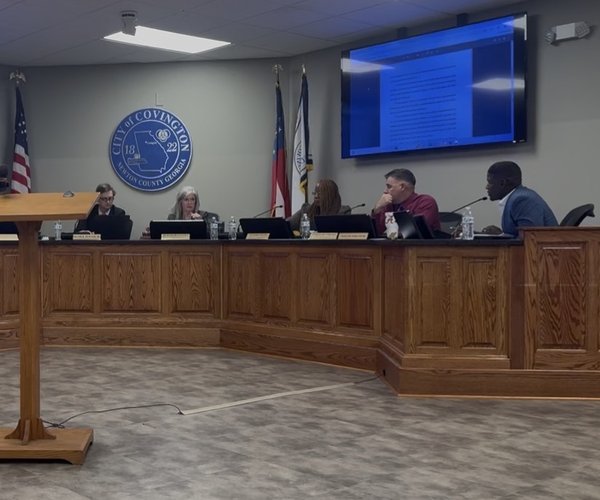
COVINGTON, Ga. — Stormwater bills were a hot topic at the Dec. 15 Covington City Council meeting. A discussion on adding the city residents’ stormwater bill to their monthly utility billing cycle quickly diverted into a conversation about alleged unpaid government accounts.
Presently, Covington residents pay a yearly stormwater bill. Councilman Jared Rutberg presented the idea of adding the stormwater charge to residents’ monthly utility bill, dividing payments into monthly installments as opposed to a once-a-year lump sum.

“I’ve gotten some citizens that have said, ‘Hey, if it was broken out over 12, one-twelfth monthly payments, that it would be easier to swallow,’” Rutberg said. “...It allows them to spread out those payments over 12 installments versus the one at the end of the year.”
Rutberg added that this would stand to increase collections by making the monthly fee a part of city utility bills. City Manager Tres Thomas shared that the city is currently receiving stormwater bill payments at about an 85-92% collection rate.
However, Councilwoman Charika Davis was not in support of turning stormwater bills into a monthly fee.
“To go ahead and do something like this, knowing that a majority of the people in this city does not want it, it’s a slap in the face,” Davis said.
Rutberg mentioned that his primary issue was not with citizen collections, but with the city’s “two largest accounts.”
“I’m talking about our two largest accounts,” Rutberg said. “The ones I’m talking about is the board of commissioners and the school system [that] have not been paying their stormwater bill.”
Rutberg says that including stormwater fees as a monthly utility bill cost would force both entities to pay, as failure to pay could result in a utility shutoff.
“My main concern is that we’ve got those two entities who refuse to pay,” Rutberg said. “And this is the only way we could make them pay.”
The alleged nonpayment has been attributed to governmental tax exemptions, City Attorney Frank Turner Jr. told the council. But the city does not view stormwater as a tax.
A City of Covington webpage titled “Understanding the Stormwater Utility Fee” explicitly states that stormwater fees are not taxes.
“The stormwater fee is not a tax, but a user fee based on a property's impact on the stormwater system,” the webpage states. “Specifically, the amount of impervious surface on the parcel, which is measured by the square foot. Impervious surfaces include rooftops, driveways, parking lots, sidewalks, and other areas that prevent water from naturally soaking into the ground.”
Turner noted that the city’s position is supported by a court case out of Athens that reportedly concluded stormwater fees are not taxes.
Councilman Anthony Henderson asked the city attorney how the city could pursue legal action on the unpaid government accounts, to which Turner replied that they would need to pursue legal action against the county and school district.
Henderson, along with Councilwoman Susie Keck, voiced support for looking into legal action against the county and the school system.
Turner advised the board to further discuss that prospect in executive session. Litigation details are typically reserved for discussion in executive session, when the council is permitted to meet behind closed doors.
Ultimately, Rutberg made a motion to table the discussion for a later executive session, which passed unanimously.
The Covington News contacted Newton County and Newton County Schools regarding the allegations of unpaid bills.
“Newton County is reviewing stormwater billing and plans on meeting with the city of Covington on this matter,” said Bryan Fazio, public information officer for Newton County, via email.
The school district returned a similar statement.
“We are aware of the recent discussion at the City Council meeting and are reviewing the matter to ensure appropriate follow-up,” said Sherri Partee, executive director of communications for Newton County School, via email.
As for general concern over stormwater fees themselves, several citizens spoke up during the public comment portion of the meeting.
Debbie Brenan took issue with cutting off utilities if a stormwater bill goes unpaid. She also recommended that the city create a way for residents to pay for stormwater in installments throughout the year without placing it on the utility bill.
Rosie Crawford spoke about her own experiences where the city has not provided aid to problems that stormwater has created on her property.
“And the last time that someone from the city came out to my property, the employee told me—when I was telling him about the creek sometimes that drain gets filled, backed up—and he told me I should have considered that before I bought the property,” Crawford said. “And I thought that was real nasty and rude when you want me to pay for stormwater.”
It remains unclear when, or if, any changes to the stormwater fee schedule will be made.