
SOCIAL CIRCLE, Ga. —The Social Circle City Council has given its unanimous support to City Manager Eric Taylor’s decision to lock the water meter at the 1-million square-foot warehouse at the intersection of East Hightower Trail and Social Circle Parkway. The federal government recently purchased the site for nearly $130 million to convert it into a U.S. Immigration & Customs Enforcement (ICE) detention center.
The detention center could house as many as 8,500 immigrants awaiting deportation to their home countries as part of a massive initiative by the administration of President Donald J. Trump. Social Circle is among the numerous cities across the country that have been targeted as detention center sites. At full capacity, the converted warehouse would nearly triple the population of Social Circle, outstripping its water, sewer and emergency services capabilities.
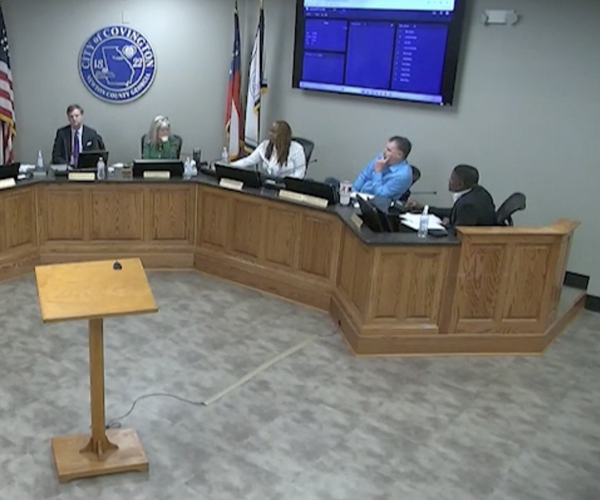
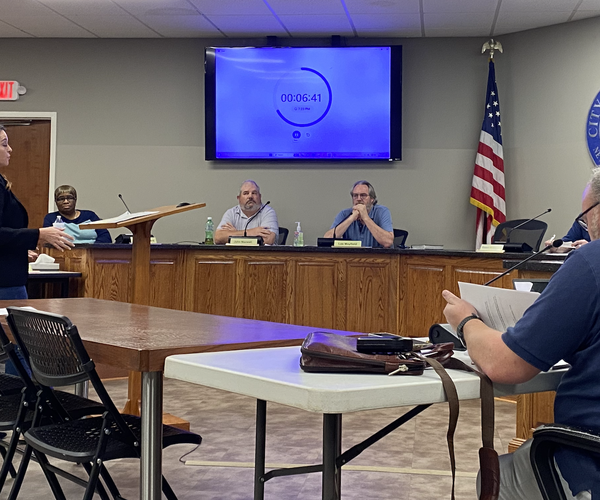
“We understand the reason why the water is off,” said Councilman Tyson Jackson at the Tuesday, March 17 city council meeting. “It’s not a political stunt. It’s just the fact of the matter that we do not have enough water. I just want to come to a vote saying that we are behind you [Taylor] on this, so it’s not Eric making the decision of having the water turned off. We’re looking out for the citizens of Social Circle right now, to make sure we have enough water for them.”
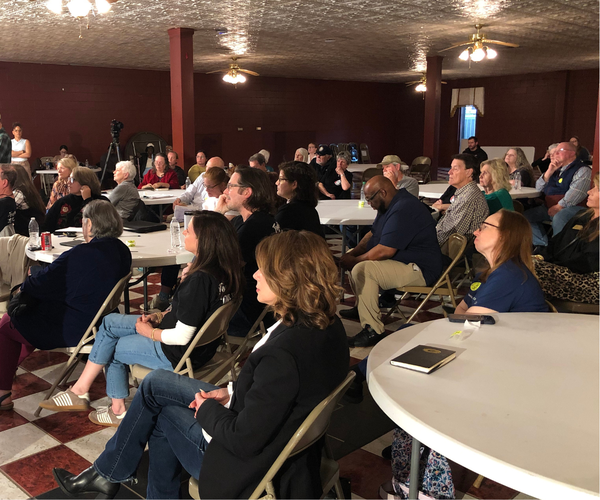
Taylor announced his unilateral decision on Thursday, March 12. He told a crowd of dozens of people at a community meeting—including a number of city and area residents and progressive activists opposed to the detention center plan—that the lock would remain in place until either the city council told him to remove it or a federal court order, in the event that ICE challenges the move, mandated that the lock be removed.
Taylor’s decision to lock the water meter was designed, as the city council recognized Tuesday, to get representatives of the Department of Homeland Security (DHS) to actively engage the city in a discussion of how the warehouse is to be integrated into the city’s infrastructure.
Councilman Adam Conavay said prior to Tuesday’s unanimous council vote that “[u]ntil we get engagement from that [DHS] team, and an accurate impact study, that they need to conduct with the proper facilities used in their study to examine the need of the town and what we can actually provide, the lock will remain in place.”
With some help from City Attorney Tony Powell in crafting the language, Conavay and Jackson, joined by Councilman Steve Shelton and Councilwoman Traysa Price, passed a unanimous motion “in support of the city manager’s decision with regard to not allowing water to be turned on at the warehouse until such time as it can be determined what their (DHS) demands and needs are in comparison to the available capacity of the city.”
“Thank you for the support,” Taylor told the council after the vote.
Mayor David Keener does not get to vote at council meetings except in the event of a tie among the four council members, but he has been clear in his opposition to the planned ICE detention center.
Among the numerous problems with the DHS plan for using the warehouse that Taylor has publicly noted are an agency proposal to pump water into storage tanks at the detention center during supposed off-peak usage hours in the city to provide the facility with water. Taylor counters that proposal by noting that only a finite amount of water is available to the city, whether it is used in off-peak hours or not.
Taylor has also been critical of a second DHS proposal to drill wells to obtain the needed water, noting that meeting the detention center’s needs would require dozens of wells, the drilling of which would endanger the water supplies of people and entities already using wells in the city.
Additionally, Taylor has questioned an assertion by DHS that it could obtain water from adjacent Newton County, noting that there is no connection between that county’s water system and the city’s water system.
Beyond that, Taylor was skeptical of the DHS proposal to truck water into the detention center, pointing out that it would take an around-the-clock steady stream of standard 6,000-gallon tanker trucks to meet detainees’ water needs.
Regarding sewerage, Taylor has questioned, among other things, a DHS proposal for on-site wastewater treatment, wondering where the treated water would be pumped after treatment, since there is no creek or river running through the warehouse property.
Public assembly ordinance
In other action tangentially related to the planned detention center—in light of numerous inquiries to the city government regarding the staging of demonstrations related to its presence—the council on Tuesday unanimously approved a public assembly ordinance.
City officials began considering changes to municipal public assembly regulations last year in connection with an increasing number of requests from organizations interested in selling doughnuts at a downtown traffic light, but the recent interest in demonstrations regarding the detention center hastened that work.
Under the new ordinance, an assembly of 15 people or more on public property requires a permit, which can be obtained from the city at a base fee of $10, according to the city’s fee table. In general, permit applications must be filed with the city manager’s office at least four days prior to the scheduled event.
The ordinance outlines a number of circumstances in which permits can be denied, including instances in which the scope of an event would require the presence of police and emergency services personnel to the extent that those services may not be adequately available elsewhere in the city.