The recent passing of Jimmy Swaggart sent my mind back to 1988. Swaggart was one of a group of televangelists during that time that gained national fame through their televisions and radio shows.
Their supporters numbered in the millions. While Swaggart never entered national politics, one of his brethren, Pat Robertson, did.
Robertson, who died at the age of 93 in 2023, shook up the Republican primary for president in 1988, at least for several months.
Robertson’s surprise entry into the Republican contest was historic on many political fronts. His success, especially in the early contests, helped make religion an even bigger part of GOP politics.
Robertson’s name recognition made him a legitimate candidate. His solid second-place finish in the Iowa caucus put him even more in the national political spotlight.
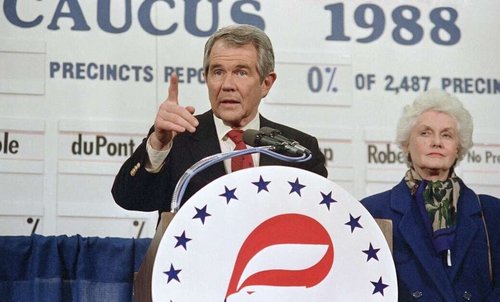
While Bob Dole won Iowa with 37.25%, Robertson finished in second place, ahead of vice president George H.W. Bush. Robertson compiled 24.5%, leaving Bush with a somewhat embarrassing third place showing at 18.6%.
That made New Hampshire an even bigger contest for Bush, who certainly could not afford another third-place showing. As it turned out, New Hampshire voters gave Bush the win by a comfortable margin.
Robertson would continue his campaign and finished ahead of Bush in both Minnesota and South Dakota.
It wasn’t until Super Tuesday on March 8, 1988, that Bush took control of the GOP race. Bush won Georgia that year with Dole and Robertson behind.
Those three were not the only top tier candidates in the race that year. Jack Kemp, Pete du Pont and Alexander Haig were also in the GOP battle, although none won any primaries.
In a bit of irony, Donald Trump was rumored to be considering a run but announced on Oct. 22, 1987, that he would not enter the race.
Robertson said he would pursue the nomination only if three million people signed up to volunteer for his campaign by September 1987. Three million responded, and by the time Robertson announced he would be running in the fall of 1987, he also had raised millions of dollars for his campaign fund. He surrendered his ministerial credentials and turned leadership of CBN over to his son, Tim.
Robertson ran on a standard conservative platform, and as a candidate he embraced the same policies as Ronald Reagan: lower taxes, a balanced budget and a strong defense.
His strong religious ties didn’t shield Robertson from controversy and his passing did not cause some to shed tears. His comments about homosexuality being the cause of the 9-11 terrorist attacks in New York had a huge backlash as being insensitive to the victims.
During the week of September 11, 2001, Robertson interviewed Jerry Falwell, who expressed his own opinion that “the ACLU has to take a lot of blame for this” in addition to “the pagans and the abortionists, and the feminists and the gays and the lesbians who have helped the terror attacks of September 11 happen.” Robertson replied, “I totally concur.” Both evangelists were criticized by President George W. Bush for their comments for which Falwell later issued an apology.
Robertson's response to the 2010 Haiti earthquake also drew negative international condemnation.
Robertson once claimed that Haiti’s founders had sworn a “pact to the Devil” in order to liberate themselves from the French slave owners and indirectly attributed the earthquake to the consequences of the Haitian people being “cursed” for doing so.
In March 2015, Robertson compared Buddhism to a disease on The 700 Club.
Despite these controversies, Robertson helped pave the way for future religious figures to become even more involved in presidential politics, either as a candidate or a supporter of various ones in the race. His influence was also seen on Ralph Reed’s campaign for Lt. Governor in Georgia in 2004. Like Robertston, Reed failed in his quest for elected office.
Chris Bridges is the managing editor of The Walton Tribune. Email comments to chris.bridges@waltontribune.com.