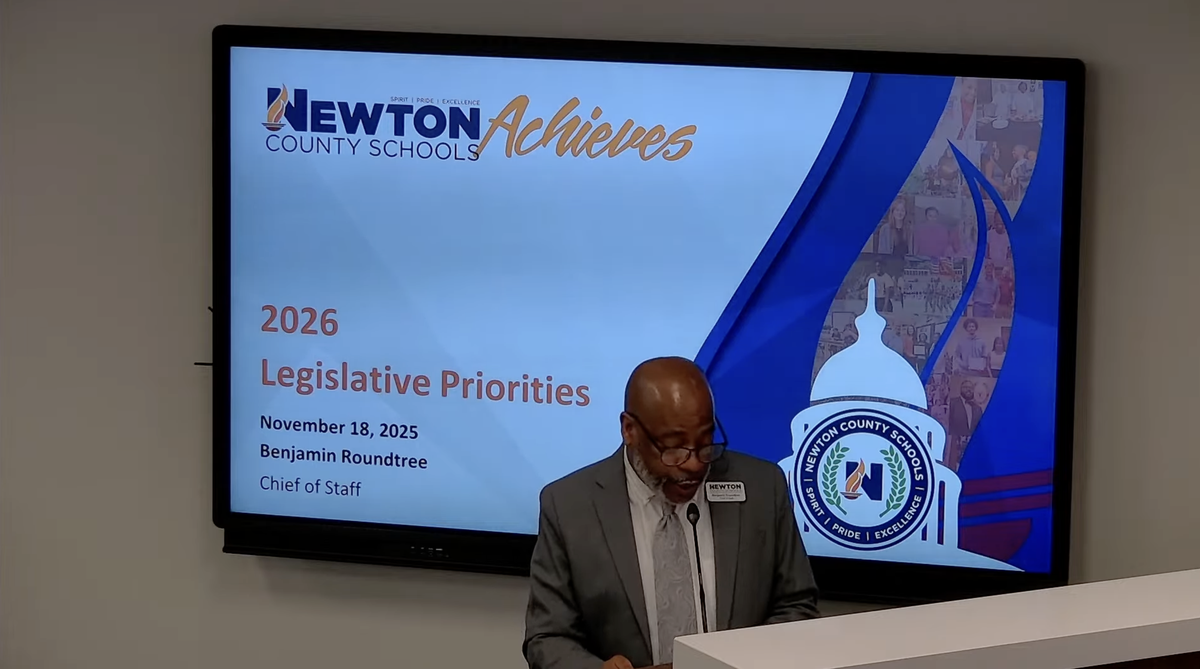
NEWTON COUNTY — At the Nov. 18 Board of Education meeting, Newton County Schools (NCS) Chief of Staff Benjamin Roundtree presented the district’s proposed 2026 legislative priorities, outlining key areas where the district plans to advocate for change at the state level. The overarching themes included increasing school funding, providing taxpayer relief, expanding opportunities for students, strengthening the educator pipeline and supporting mental health and safety.
Property tax pressure and funding reform
Roundtree began with one of the most urgent community concerns: taxpayer relief. Despite the Board of Education lowering the millage rate, rising property values continue to drive up local tax bills.
“Our county continues to experience rising property values, resulting in annual increases in local tax bills, even as the board has reduced the millage rate to historic lows,” he said.
Compounding the issue is Georgia’s Local Fair Share requirement, which dictates how much local revenue school districts must contribute before receiving state funding. That burden has grown dramatically in Newton County. The district’s Local Fair Share requirement has increased by 46%.
“This shift places a larger share of the responsibility for funding education on local taxpayers,” Roundtree said. “Despite the board’s efforts to provide relief, the cost of operating a well functioning school system rises each year.”
To address these pressures, NCS outlined three major funding priorities:
Modernize the Quality Basic Education (QBE) formula to reflect the real cost of educating students in today’s economy.
Reduce reliance on local property tax revenue within the QBE model.
Reimagine the school funding structure so districts can sustain operations without placing additional financial strain on homeowners.
“By refining the QBE formula to reduce overreliance on local property revenue, the state can help protect taxpayers while sustaining the funding necessary to serve all students well,” Roundtree said.
The district is also pushing for the option to pursue an Education Local Option Sales Tax (ELOST), an idea frequently cited in community feedback, allowing districts to reduce dependence on property taxes while maintaining consistent operating revenue.
Addressing the educator shortage
Another major priority centers on Georgia’s educator workforce. Roundtree said students and families consistently stressed the need for districts to attract and retain highly qualified teachers, noting that compensation must keep pace with job demands.
“Newton County Schools, like many districts across Georgia, is competing for a shrinking pool of teachers and support staff,” he said. “Families expect stable, well staffed schools and educators want to know that their work and experience are valued.”
Survey data showed that strengthening teacher pay and workforce support was among the strongest themes to emerge from community responses.
District 1 Representative Trey Bailey noted the need for advocacy at the state level, especially if legislators remain reluctant to update Georgia’s school funding system.
“While we can’t force the legislators to do anything and we can’t control property assessments, what we can do is come together as a board, with other local boards of education, and we can advocate for a new funding mechanism for public education as we see the cost continue to go up and the state hesitant to change the QBE formula, the ways the dollars are calculated,” Bailey said.
Bailey said he strongly supports the proposed local sales tax option, arguing it could relieve property owners and diversify the district’s funding stream.
“Particularly in Newton County, we can use those tourism dollars to let all of our vampire friends help pay for our students’ education,” he joked, referencing the county’s tourism draw created by “The Vampire Diaries” filming locations.
Superintendent Dr. Duke Bradley III said he hopes families feel their voices are reflected in these priorities.
“Hopefully our community is beginning to see that when you express what you are interested in, you see that manifested through the work that we actually do,” Bradley said.
At the end of the discussion, Bailey made the motion to approve the 2026 legislative priorities, and District 3 Board Member Shakila Henderson-Baker seconded the motion. The motion passed unanimously.