COVINGTON, Ga. – The Covington City Council voted against adopting an ordinance decriminalizing possession of one ounce or less of marijuana at their March 2 meeting. With the council voting 2-4, the motion to adopt the change failed to pass, and no new action has been put into place.
Council Member Anthony Henderson initiated the conversation. He proposed eliminating jail time for those charged with possession of an ounce or less of marijuana. Rather, punishment would be doled out solely via fines that increase with subsequent offenses, and possible community service.
This proposed ordinance would also clarify that the violation is civil, not criminal. The defendant would also be reserved transfer rights if the case is appropriate to move to state courts.
Henderson stated that he had originally encouraged action on this issue in 2018, but state law changed with the introduction of hemp in 2019. He noted that this action would align Covington with other communities in the state like Clayton County, Fulton County, Athens and Atlanta.
“Each day we wait is another day Covington residents face disproportionate penalties compared to those living just minutes away or in the same state,” Henderson said.
City Attorney Frank Turner Jr. further elaborated that cities do not have the power to pass criminal laws that are more strict or less strict than state law under the Georgia Constitution. While other cities are enacting such measures, Turner believes that they would be found unconstitutional if challenged in a court of law.
O.C.G.A. §16-13-2(b) states that possession of an ounce or less of marijuana is a misdemeanor punishable by up to one year of incarceration or a $1,000 maximum fine. Possessing more than an ounce is a felony offense, punishable by 1-10 years of incarceration or a $5,000 maximum fine.
Henderson said nothing in his proposed city ordinance hinders state law, but it revises how Covington would handle these cases in its municipal courts by “offering a proportionate local option.”
“My intention isn’t to encourage anyone to violate our ordinance or state law,” Henderson said. “It’s my goal to save officers’ time, save taxpayer dollars, save families and individuals a chance to correct their mistakes.”
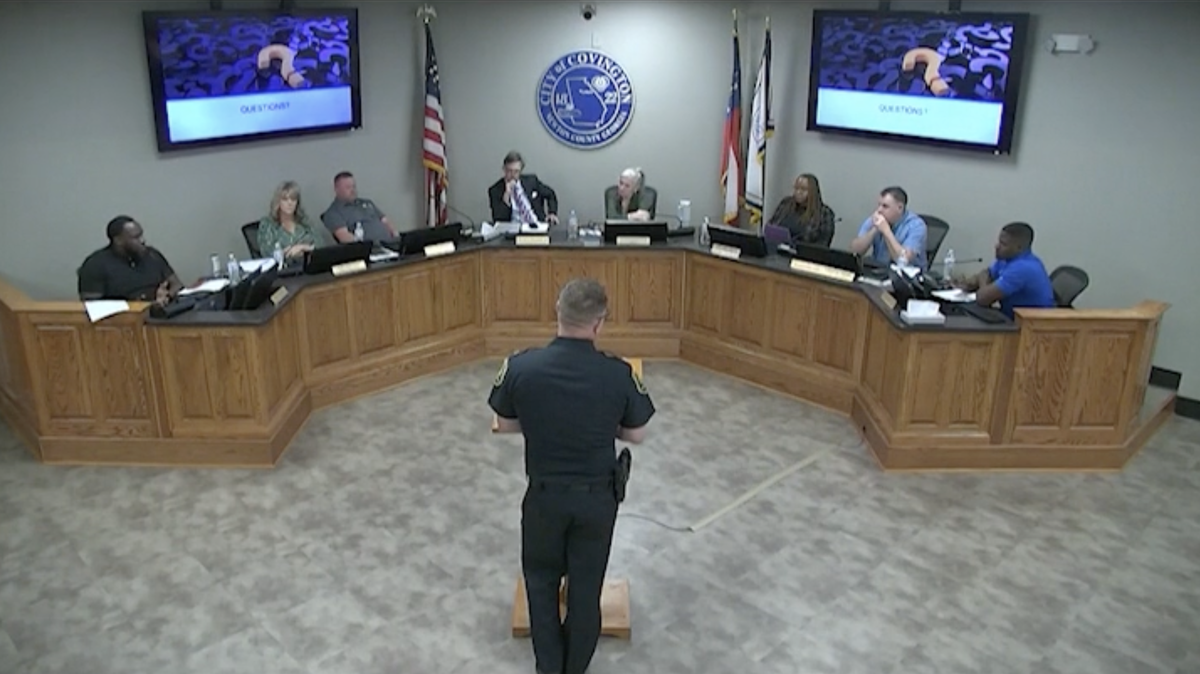
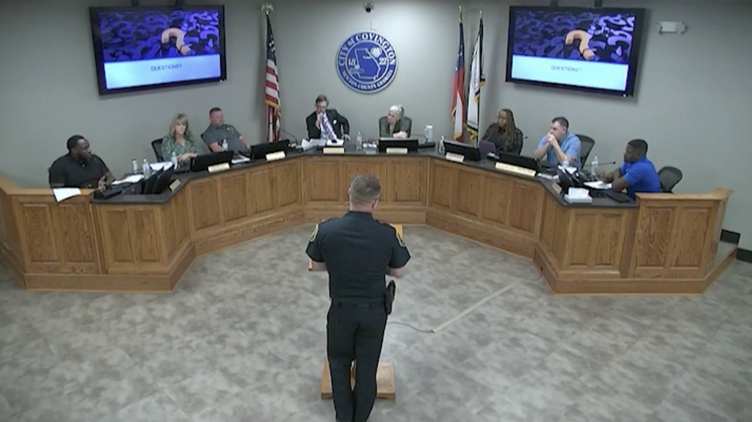
Brent Fuesting, chief of the Covington Police Department, took the podium to address council members' concerns and answer questions about the department’s current policies.
Fuesting said that the district attorney does not prosecute for a sole misdemeanor possession of marijuana charge. Rather than arrest those found with that amount, officers just write a report and submit the drugs for destruction. Any possession charge above one ounce goes up to the superior courts.
“We never charge a sole possession of marijuana charge unless there’s some other mitigating circumstances,” Fuesting said.
Since the legalization of hemp, Fuesting said officers cannot determine if a substance is hemp or marijuana by looking at it. The difference can only be determined by an out-of-house chemical test that Fuesting said costs around $650.
Council member Dwayne Turner added further insight from his experience in law enforcement, sharing that police policy comes from Georgia state law, and conflicting rules from a city ordinance can put an officer in a tight spot. He said that most jurisdictions destroy the drugs without charging the offender due to the level of offense and the cost of the test.
“Sending marijuana to the GBI to test for $650 is ridiculous if it's under an ounce,” Dwayne Turner said. “I don’t think any county or city even does that. My own county, we sit there and we just destroy it, call it a day. We don’t charge them. Most [district attorneys] don’t even pursue charges if it’s less than an ounce.”
Ultimately, Henderson voted in favor alongside Council Member Charika Davis, but did not garner enough support to pass the motion.