OXFORD, Ga. — The Newton County Composite Squadron of the Civil Air Patrol proudly took part in the city of Oxford’s Independence Day celebrations on Friday.
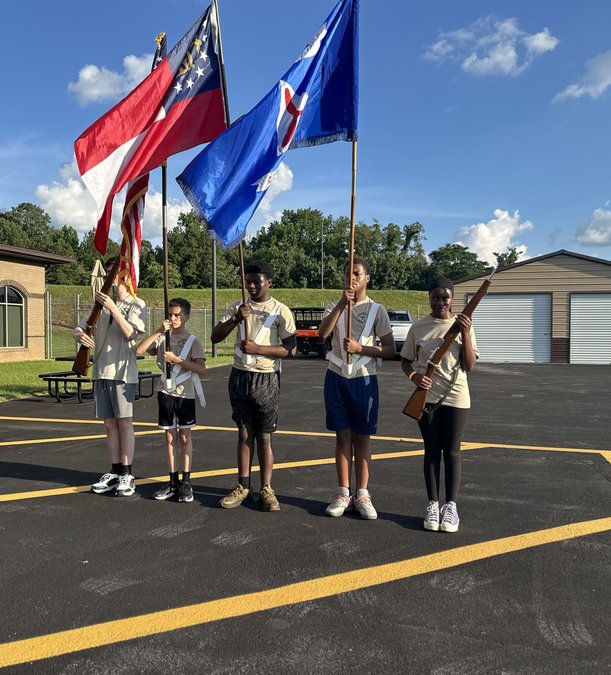
Five cadets presented the colors for the National Anthem: Cadet Airman Chadwick McGuire, Cadet Airman First Class Amaziah Cooper, Cadet Staff Sergeant Wolfgang Mayes, Cadet Staff Sergeant Nicholas Liford and Cadet Master Sergeant Connor Stewart. They are presided over by Captain Chadwick McGuire.
This year is the first year that the Newton County group will participate as a composite squadron. They were recently transitioned from a cadet squadron to a composite squadron, which allows them to conduct both a cadet program and a senior member program. This designation also grants them additional capabilities, such as performing emergency services
“...we became a composite squadron recently,” said Major Mark Stumpf, squadron commander of the Newton County Composite Squadron of the Civil Air Patrol. “That was my goal when I first became commander last year. And so we would have cadets and adults. Why that's important is when you're a cadet, you can be a cadet until you're 20.”
According to Stumpf, the squadron’s participation in the Oxford Independence Day celebrations and parade has been “on-again, off-again” for decades. However, they did participate in last year’s festivities as a cadet squadron.
The Civil Air Patrol’s cadet program is similar to the better-known Junior Reserve Officers' Training Corps (JROTC), but is an Air Force alternative.
Stumpf explained that being a Civil Air Patrol cadet makes you a part of the Air Force, while JROTC members are not technically in the Army.
“The high schoolers like to say that we're ROTC-like,” Stumf said. “The truth is, we actually, we're a part of the U.S. Air Force. We're part of what's called the Total Force.”
The Total Force of the U.S. Air Force is composed of the active-duty Air Force, the Air National Guard, the Air Force Reserve, the Department of the Air Force civilians and the Civil Air Patrol.
“Junior ROTC is not up there,” Stumpf said. “So we actually have a real mission that's part of the search and rescue program.”
A Civil Air Patrol’s role is largely centered around performing search and rescue operations across the country. Stumpf explained that the Newton County squadron is not incredibly active on a daily basis, but stays ready.
For example, though Newton County’s squadron was not called to serve, many southeastern Civil Air Patrol squadrons came to life during the aftermath of Hurricane Helene. In other regions of the country, such as Alaska, Stumpf said that being in the Civil Air Patrol is comparable to a full-time job, as they are regularly called upon to perform search and rescue operations due to aircraft accidents or missing persons.
But beyond this opportunity to serve the public and help others, Stumpf believes that taking part in the Civil Air Patrol can appeal to those who may struggle to find a role in traditional enlistment.
“Although we're part of the Air Force, we're not really like the Air Force where you have to be physically fit and things like that,” Stumpf said. “So you have people who are less fit, but they can still serve their country.”
The Civil Air Patrol lacks some of the physical requirements that the traditional military entry points have. This makes a way for those who may have physical differences that keep them from being able to enlist.
“It gives a place for these people that… they'll never serve in the military because they have physical problems,” Stumpf said. “They're disqualified from military duty. So this gives them a place to land and still serve their country and have purpose. And that's what I like about it. That's where I see the Civil Air Patrol in our area.”
Stumpf said that there are currently about two dozen students participating in the local cadet program. Though they will only be presenting the colors for Oxford’s celebration this year, the group has marched the parade route before.
But according to Stumpf, Air Force-style marching is much more taxing than it may appear and takes some training to be ready for. In past years, when cadets marched in the parade, they left with “horrible blisters.”
Though cadets who pass through this program do learn these technical skills related to aviation and get an introduction to military service, Stumpf aims for them to take away more than Air Force-specific instruction.
“We're not really a recruiting service for the Air Force, although you can move through our ranks and you can benefit in the military from what you do in our organization, but that's not why I want to have the squadron,” Stumpf said. “I want children to see what right looks like and induce upon things at the same time.”
The cadets meet on Monday nights from 6:30 p.m. to 8 p.m. Adults meet on Thursday evenings.
“Anybody can join,” Stumpf said. “You don't have to be in the military or have any military experience. You have to be a U.S. citizen. And you can't have a back record. But aside from that, anybody can join…it’s a lot of fun.”