COVINGTON, Ga. — The City of Covington Planning Commission issued a recommendation to the city council that tattoo studios be allowed via a special use permit in the Town Center Mixed-Use District (TCM), which contains downtown and the Square.
The planning commission heard the request on Tuesday, March 10, after the city council instructed staff to look into making the zoning addition during its Feb. 2 meeting. The city council will hear the item at its Monday, March 16 meeting. While the planning commission is solely a recommending body, the council’s vote would be enshrined in city law.
During Tuesday’s meeting, the planning commission took a three-pronged approach to the topic.
Knowing that the city council has the authority to align with or disregard the commission’s recommended action, the planning commissioners opted to first pass definitions and supplemental regulations. That way, if a scenario arose where the commissioners recommended that the council not pass the zoning amendment and the council was leaning towards adopting it anyway, there would still be commission-approved regulations for the council to consider.
Definition and Regulations discussions
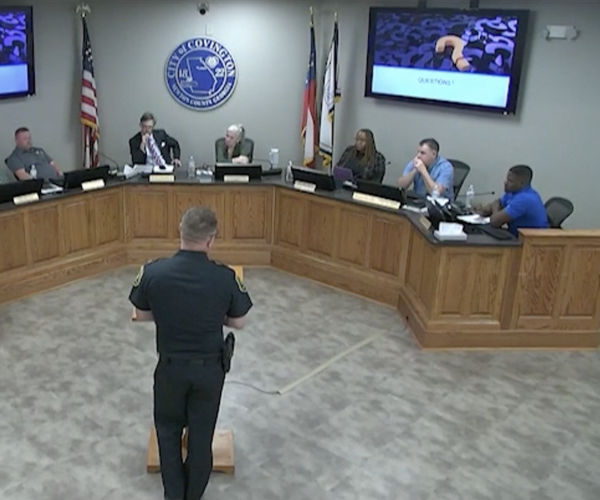
Judy Thagard, the city’s director of planning and development, presented the proposed changes to the commissioners. Among the amendments was a new, more detailed definition for “tattoo and body piercing parlor/studio” in the city’s ordinances.
The previous definition stated that tattoo studios were establishments that specifically provided the service of body piercing and/or tattooing.
If passed by the city council on Monday, the newer definition would specify that the business is a commercial establishment and name tattooing, body piercing, branding, scarification, or similar body art procedures as defined activities. It also explicitly allows for accessory retail services for related products, but excludes medical procedures that would be performed by a licensed professional.
The commission obliged Thagard’s request to strike the word “parlor” from the verbiage.
“I think it’s a very dated term, and I’m not sure that it is appropriate for today,” Thagard said.
Thagard also presented the commission with supplemental use provisions that would further regulate tattoo studios.
“Portion A” of the proposed regulations would apply to all tattoo studios in the city, regardless of zoning location. “Portion B” was a specific list of regulations that would apply to studios only in the TCM district—if the city council opts to allow them.
The commission voted unanimously to recommend “Portion A” of the regulations, noting to strike the word “parlors.” These conditions, if adopted, would require operations to be indoors, reiterate that all required state and local licenses and permits be maintained, create a standard for interior, exterior and adjacent sidewalk cleanliness, and require professional conduct, meaning no alcohol or illegal substances on this site.
“Portion B,” the TCM-specific regulations, brought out more discussion.The suggested regulations presented by Thagard included additional stipulations: Distance requirements, hour limitations, appearance standards, artwork/display visibility and noise regulations. The commission discussed many of the points at length, weighing the strictness of implementing the standards.
While Thagard’s recommended 100-foot buffer from lots zoned or used for single-family residences and 200-foot buffer from schools were not changed, the commissioners did add a third setback requirement to the recommended conditions, which would prohibit tattoo studios from existing within 500 feet of one another in TCM.
Other distances of 1000 feet and 300 feet were considered, but the 500-foot decision seemed to reflect the commission’s interest in allowing competition in TCM while keeping the number of studios that could open on the Square itself low.
Hours of operation were also discussed, with Commission MemberAdam Holcombe advocating to strike them from the requirements entirely. While the proposed regulation suggested limited hours between 8 a.m. and 10 p.m., Holcombe said that a tattoo studio’s hours should be able to reflect the existing businesses around it, and some of TCM’s restaurants stay open well past midnight.
Commission Member Bobbie Shepherd said that she supported applicants having to request additional hours in a special use permit if they wished to operate past 10 p.m. But Planning Commission Chair Shawn McGovern noted that there would be no need to request later hours if a regulation did not exist.
“The issue with that is they could have any hours,” McGovern said. “And they don’t have to request hours if you do not identify it in here. If you identify it as part of a base code, then they are restricted unless you request it, whereas if you do it the other way, they’re unrestricted and they’ll never request it.”
Ultimately, Holcombe’s motion to strike the hour regulations failed for lack of support.
To recommend or not to recommend
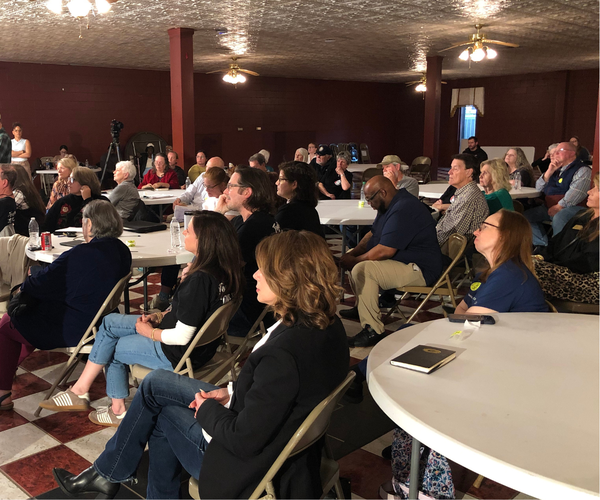
With regulatory conditions approved to recommend to the city council, the planning commission moved to the item that their sizable audience had been waiting for. It was time for a discussion on whether to recommend that the city council approve adding tattoo studios as permitted by a special use permit in TCM.
Commission Member John Travis immediately voiced his opposition, asking why this was something that the downtown area would need.
“Personally, I think commercial and M1 is adequate,” Travis said. “And I think we have every right to be discerning as far as what businesses are permitted in the TCM area. We haven’t done a very good job, in my opinion, of protecting downtown historic district, and I just don’t see it as adding anything to the downtown.”
Travis’ stance aligned with Barbara Morgan, the lone citizen who spoke against the idea during the designated time to voice opposition. Morgan shared how she supports maintaining the Square’s makeup from a historical standpoint.
“So much effort has gone into protecting our downtown square,” Morgan said. “It’s historic. It’s unique. It’s beautiful. It makes us special. And I certainly don’t think one [a tattoo studio] ought to be allowed on the Square, per se.”
Commission Member Lee Mayfield also said he did not support adding tattoo studios to the TCM zoning, saying that there are many kinds of businesses he feels do not belong there.
“I don’t think we want doctors downtown,” Mayfield said. “I don’t think we want pet shops downtown. I don’t think we want vape shops downtown. I don’t think we want liquor stores downtown. I think there’s a place for all of that, but I don’t think it is in our TCM area that we advertise as what makes us different as a community.”
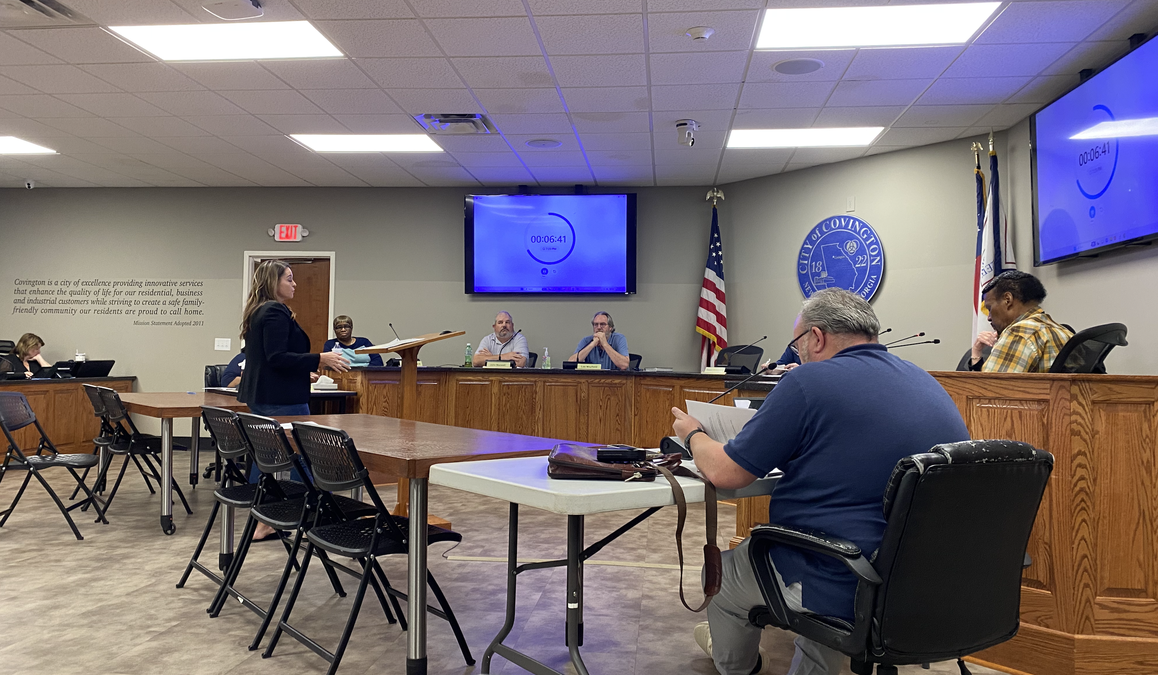
During the public comments, tattoo artist Jessica Sells spoke in favor of the rezoning. Sells spoke to the city council in their February meeting, as she was looking to open a tattoo shop on the Square herself.
“Where it may be a concern of the visibility of the walking Square area, there are still other spaces that are zoned in TCM that are still able to be salon-use, which is technically what we are, is a personal service salon,” Sells said.
Sells noted that she has since located another vacant space on Emory Street that she is actively pursuing instead. The space remains in the TCM district, albeit off the Square.
Commission Member Felicia Sanders spoke favorably of the rezoning, mentioning women with breast cancer and veterans as groups of people who sometimes seek tattooing to cover scars. Holcombe reiterated that he was opposed to overregulating businesses.
Ultimately, a motion to recommend that the city council allow tattoo studios in TCM via a special use permit was made by Holcombe and seconded by Shepherd. It passed 5-2, with Travis and Mayfield voting against.